

Does Low Temperature Affect The Battery?
Low temperature can significantly affect battery performance, especially for lithium batteries.
When the temperature drops, the chemical reactions inside the battery slow down. This means the battery cannot deliver power as efficiently as it does at normal temperatures. As a result, users may notice reduced capacity, lower voltage, slower charging, and weaker overall performance.
One of the most common effects of low temperature is capacity loss. A battery that normally provides full power at room temperature may only deliver part of its rated capacity in cold conditions. For example, in winter environments, batteries often appear to “run out” faster, even though they are not actually damaged. This happens because the battery’s internal resistance increases in cold weather, making it harder for energy to flow smoothly.
Low temperature also affects charging. Charging a battery in freezing conditions can be risky, particularly for lithium-ion batteries. At very low temperatures, lithium plating may occur during charging, which can permanently damage the battery and shorten its lifespan. For this reason, many lithium batteries include a Battery Management System (BMS) with low-temperature charging protection to prevent charging when the temperature is too low.
In addition, cold weather can reduce discharge efficiency. Equipment powered by batteries, such as marine devices, RV systems, solar storage, and electric vehicles, may experience weaker output or shorter runtime in winter. In severe cold, the battery may even fail to start certain applications if sufficient power cannot be released quickly.
However, low temperature does not always mean permanent battery damage. In many cases, once the battery returns to a suitable operating temperature, performance improves again. The main concern is improper charging in cold conditions and long-term exposure to extreme temperatures.
To reduce the impact of low temperature on batteries, users should store batteries in a moderate environment, avoid charging below the recommended temperature range, and choose batteries designed with low-temperature protection or self-heating functions when used in cold regions.
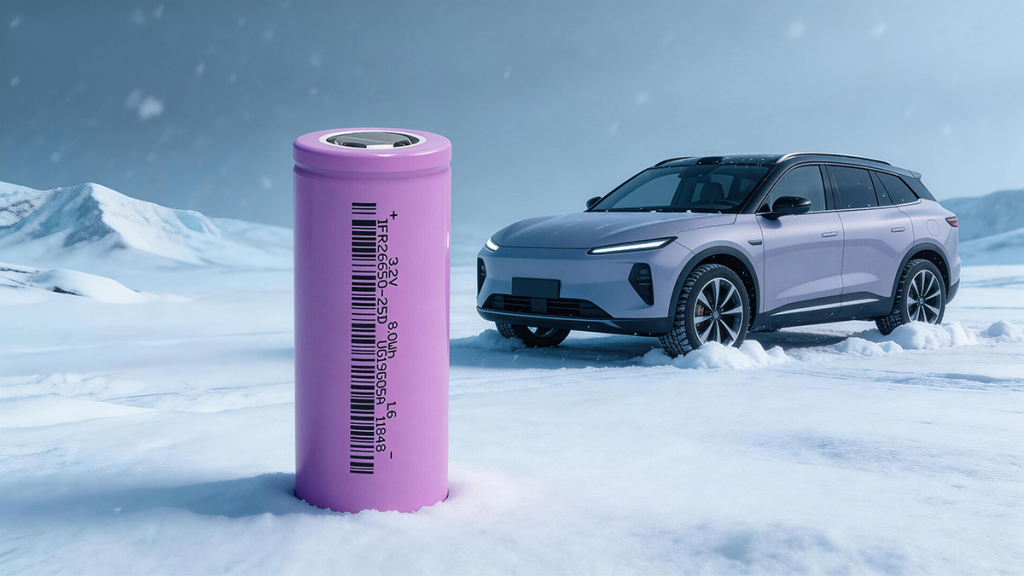

PLB Develops a Low-Temperature 26650 Battery Cell for Extreme Cold Applications
PLB has successfully developed a high-performance low-temperature 26650 battery cell designed to operate reliably in extremely cold environments. This advanced battery cell is specially engineered for applications that demand strong power output, high safety, and stable performance under harsh weather conditions. One of its key application directions is vehicle starting batteries, where dependable cold-weather performance is essential.
In many cold regions, traditional batteries often suffer from serious performance loss when temperatures drop. Problems such as reduced capacity, weak discharge ability, slow charging, and difficulty in starting vehicles are common challenges. To solve these industry pain points, PLB has introduced this innovative low-temperature 26650 cell, which combines excellent low-temperature adaptability, high-rate discharge capability, and stable charging performance.
The new PLB low-temperature 26650 battery cell offers an impressive discharge operating temperature range of -40℃ to 60℃, allowing it to continue delivering power even in extremely cold winter conditions. In addition, its charging operating temperature range of -20℃ to 60℃ ensures efficient charging performance in a much wider environment than conventional battery cells. This makes it a highly practical solution for equipment and vehicles used in cold climates.
For high-power applications, this cell demonstrates outstanding performance. It supports a pulse discharge current of 80C at 1 second, enabling it to release a large amount of power instantly when needed. This is especially important for vehicle engine starting, where batteries must provide strong burst power in a very short time. At the same time, the cell also supports a maximum continuous discharge current of 50C, ensuring stable and sustained high-power output during demanding operations. Its maximum continuous charging current of 7C further reflects its excellent fast-charging capability, helping improve efficiency for end users and system manufacturers.
The battery cell has a capacity of 2500mAh, striking a good balance between energy storage and high-rate performance. With this design, it is well suited not only for vehicle starting batteries, but also for a wide range of applications such as automotive systems, motorcycles, emergency power equipment, outdoor devices, energy storage systems in cold areas, and other power products requiring reliable low-temperature operation.
PLB’s development of this low-temperature 26650 battery cell demonstrates the company’s strong R&D capability and commitment to innovation in lithium battery technology. By focusing on customer needs in challenging environments, PLB continues to provide advanced battery solutions that offer high power, wide temperature adaptability, and dependable safety performance.
As demand grows for batteries that can perform in extreme climates, PLB’s low-temperature 26650 cell is expected to become an ideal choice for manufacturers of vehicle starting batteries and other cold-environment power systems. With its combination of -40℃ low-temperature discharge performance, high pulse current, and strong continuous output, this product opens new possibilities for reliable power supply in winter and other harsh operating conditions.